Category: Used Car

  • Maximizing Your 2026 Tax Refund Car Down Payment: An Insiderโ€™s Guide

    Maximizing Your 2026 Tax Refund Car Down Payment: An Insiderโ€™s Guide

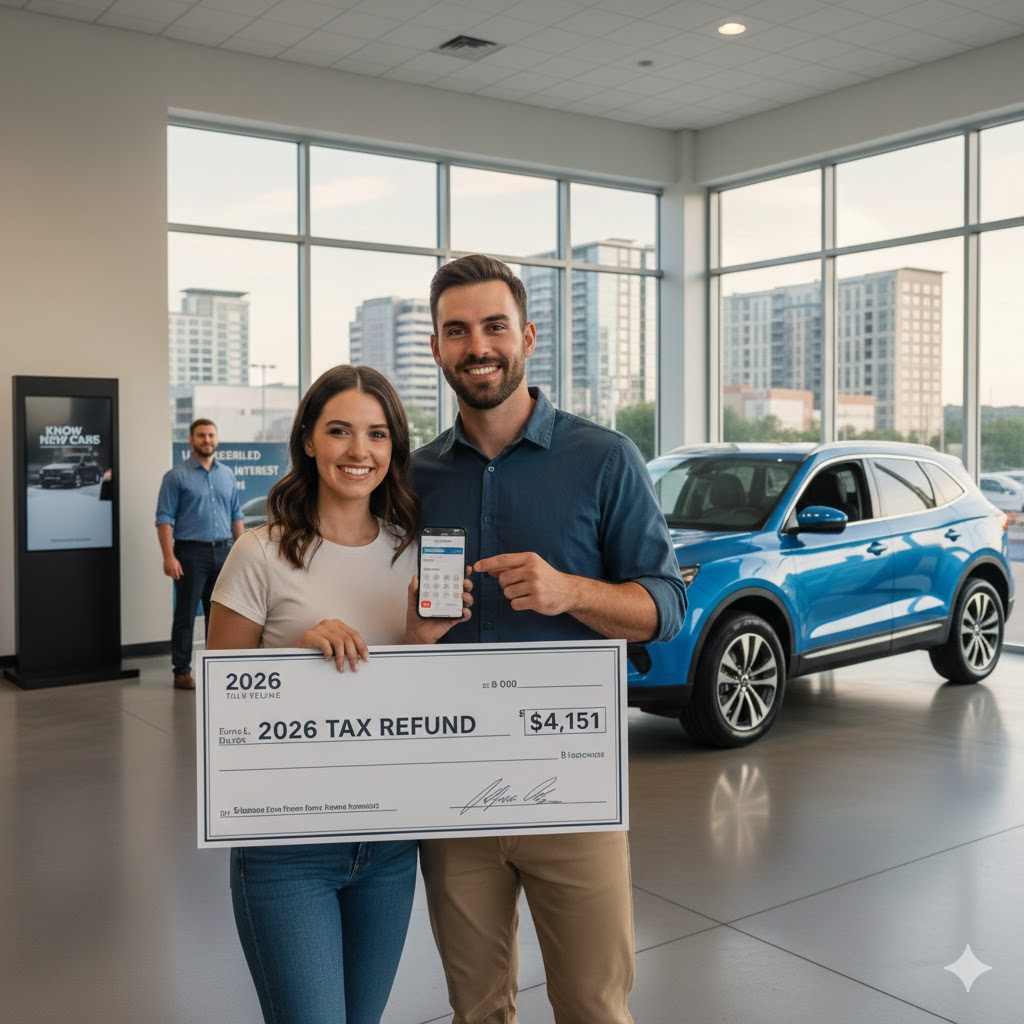
    Tax season this year is a historic opportunity for those needing to maximize their 2026 tax refund car down payment impact. Thanks to the retroactive provisions in the One Big Beautiful Bill Act (OBBBA), the White House reports that average federal refunds have surged to $4,151โ€”a $1,000 jump from last year.

    As a former vehicle buyer, I know that dealerships are salivating over these direct deposits. They want your refund to disappear into their “back-end” profits. But if you play your cards right, you can use your 2026 tax refund car down payment to escape debt or secure a vehicle that actually builds equity.

    Here is how to strategically deploy your cash based on your current equity position. For more on small down payment strategy: Buying a Used Car with $1,000 Down: 2026 Insider Strategy


    1. The “Underwater” Strategy (Negative Equity)

    If you owe more than your car is worth, you are part of a growing trend. Edmunds data for 2026 shows that negative equity has hit a four-year high as used car values normalize.

    • Small Refund (<$2,000): Do not go to a dealership. Instead, apply this directly to your principal balance. With used car interest rates still averaging near 11%, a $2,000 “principal-only” payment can save you over $500 in future interest.
    • Large Refund ($4,000+): This is your “get out of jail free” card. Use this as a 2026 tax refund car down payment specifically to bridge the equity gap. This allows you to trade in your current “sinkhole” without rolling that debt into a new, 84-month loanโ€”a cycle that keeps most consumers perpetually broke.

    2. The “Break-Even” Strategy

    You owe roughly what the car is worth. You have freedom, but no leverage.

    • Small Refund (<$2,000): Invest in “Preventative Equity.” Cox Automotive notes that while prices have stabilized, the cost of labor is up significantly. Use $1,200 for a major 100k-mile service. Keeping a paid-off car running is the fastest way to grow your net worth. Investing your 2026 tax refund car down payment into maintenance should be the better long-term strategy.
    • Large Refund ($4,000+): Target the “Off-Lease Surge.” In 2026, S&P Global Mobility predicts a flood of lease returns. This creates a “sweet spot” for 3-year-old used cars. A $4,000 down payment on a $22,000 off-lease sedan puts you in a position where you’ll likely have positive equity within 18 months.

    3. The “Positive Equity” Strategy

    You own your car or owe very little. You are the “White Whale” for Austin dealers.

    • Small Refund (<$2,000): Go for the “Tech Refresher.” Spend $800 on a modern CarPlay/Android Auto head unit and a professional detail. This “new car feel” is the best defense against the urge to take on a $1,000 monthly payment.
    • Large Refund ($4,000+): Capitalize on the U.S. Assembly Interest Deduction. A major OBBBA win allows you to deduct up to $10,000 in loan interest on new, U.S.-assembled vehicles. By combining your trade-in equity with a $4,000 refund, you can buy a new truck or SUV and write off the interest, effectively lowering your 2027 tax bill.

    The “Know New Cars” Pro Tip

    Dealers often use “tax season specials” to hide inflated fees. To win, negotiate the “Out-the-Door” price of the car before you mention your 2026 tax refund car down payment. Your refund is your moneyโ€”make the dealer work to earn it.

    Before heading to the dealer, check out more on how to prevent being denied. More: Denied for a Car Loan โ€“ 3 Hidden Reasons Why (and How to Fix Them Fast)


    Primary Sources:

  • Denied for a Car Loan – 3 Hidden Reasons Why (and How to Fix Them Fast)

    Denied for a Car Loan – 3 Hidden Reasons Why (and How to Fix Them Fast)

    You found the perfect used SUV, the price was right, and you were ready to sign. Then the finance manager walked back into the office with that awkward look on their face: “Iโ€™m sorry, but the bank couldnโ€™t approve the loan.” Boom – you’ve just been denied for a car loan.

    Itโ€™s a gut punch. Most people immediately assume it’s their credit score, but as a former trade-in specialist and buyer, I can tell you that credit is only one piece of the puzzle. In 2026, lenders are tighter than ever. According to recent Auto Finance News data, while delinquency growth is slowing, lenders are using more advanced AI-driven models to scrutinize every detail of your application (Auto Finance News, 2026).

    If you are looking to buy or trade in within the next 30 days, you need to understand the real reasons for a rejection. Here is why you might have been denied and how to flip that “No” into a “Yes.” Or, skip all that and check out The Best Urban Commuter Hack: Why You Need a 50cc Scooter in 2026.


    1. Your Loan-to-Value (LTV) is Out of Whack

    The most common reason for a denialโ€”that isn’t your credit scoreโ€”is a high Loan-to-Value (LTV) ratio.

    Lenders don’t just look at you; they look at the car. The LTV is the total loan amount divided by the vehicle’s actual value. In the used car world, banks don’t care what the “sticker price” is; they care about the Wholesale Blue Book or NADA Clean Trade value.

    The Math: If a car is worth $15,000 but you are asking to borrow $18,000 (to cover taxes, fees, and a service contract), your LTV is 120%.

    Many lenders cap LTV at 110% or 115%. If you’re asking for more than the car is worth as collateral, the bank sees too much risk and you’ll be denied for a car loan. To fix this, you either need a bigger down payment or a cheaper car.

    2. The “Negative Equity” Trap

    If you are trading in a vehicle, you may be denied for a car loan because of your old car, not your new one.

    Negative equity (being “upside down”) happens when you owe more on your current loan than the dealer offers for the trade-in. If you owe $10,000 on a car only worth $7,000, that $3,000 difference has to go somewhere. Usually, you try to “roll” it into the new loan.

    However, as we discussed with LTV, most banks won’t let you borrow 130% of a car’s value just to cover your old debt. If you are shopping in the next 30 days, check your payoff amount versus your carโ€™s current trade-in value before you visit the lot.

    3. Payment-to-Income (PTI) Limits

    You might have a 750 credit score and $0 debt, but if the monthly payment on that truck is $900 and you take home $3,000 a month, the bank will likely flag your Payment-to-Income (PTI) ratio.

    Most lenders want your car payment to be no more than 15% to 20% of your gross monthly income. If the car you picked pushes you over that limit, you’ll get an automatic denial. Cue, “Why was I denied for a car loan?”


    How to Get Approved in the Next 30 Days

    If you’ve been denied, don’t just keep applying at different dealershipsโ€”that will only hurt your credit further. Don’t find yourself asking, ‘why was I denied for a car loan?’ ever again. Instead, try these three “Insider” moves:

    • Target “High-Value” Used Cars: Some cars (like Toyotas or Hondas) hold their wholesale value better. A bank is more likely to approve a loan on a vehicle that they know they can resell easily if you default.
    • The 14-Day Window: If you are shopping around, make sure all your loan applications happen within a 14-day window. Per TransUnion guidelines, multiple inquiries for an auto loan within this timeframe are often treated as a single “hit” to your score (TransUnion, 2026).
    • Cash is King: Even $500โ€“$1,000 can be enough to bring an LTV ratio down from “Denied” to “Approved.”
    • Read: Buying a Used Car with $1,000 Down: 2026 Insider Strategy

    Summary of Car Loan Factors

    FactorWhat it MeansHealthy Range
    LTVLoan amount vs. Car value100% – 110%
    PTIPayment vs. Monthly IncomeUnder 15%
    DTIAll debt vs. Monthly IncomeUnder 45%

    “Why was I denied for a car loan?” You aren’t now, friend!

  • The Ultimate Urban Commuter Life Hack: Why You Need a 50cc Scooter

    The Ultimate Urban Commuter Life Hack: Why You Need a 50cc Scooter

    If you are an urban commuter currently looking to purchase a vehicle or trade in your car within the next 30 days, I have a counterintuitive piece of advice: Donโ€™t just buy a car. As a former vehicle buyer and trade-in specialist, Iโ€™ve appraised thousands of cars that were “city-driven” to death. Urban environments are the natural enemy of the internal combustion engine. If your daily life consists of short trips to the grocery store, gym, or office, you are the prime candidate for the most overlooked tool in the urban commuter toolkit: the 50cc scooter.


    1. Stop Killing Your Car with “Short-Trip Sludge”

    The biggest insider secret in the car industry is that “low mileage” doesn’t always mean “good condition.” Short trips (under 5 miles) are catastrophic for car engines. According to research from Valvoline Global, an engine needs at least 15 minutes of driving to reach an optimal operating temperature.

    When you drive 2 miles to the store and turn the car off, moisture and unburnt fuel collect in the oil. This leads to:

    • Engine Sludge: Oil turns into a thick gel that blocks lubrication.
    • Corrosion: Acids formed during cold starts eat away at your exhaust and engine internals.
    • Battery Drain: A car’s alternator often cannot recharge the energy used to start the engine in a short trip, leading to premature battery failure.

    By using a 50cc scooter for these errands, you preserve your car for the long trips it was designed for.

    2. Radical Fuel Efficiency: 100+ MPG

    For the urban commuter, fuel is a primary overhead cost. While the average car in the U.S. gets roughly 24.4 MPG (per U.S. Department of Energy data), a 50cc scooter is a different beast entirely.

    Standard 50cc models, like the Honda Metropolitan, frequently achieve 80 to 110 MPG. In a typical city scenario, you can cover your entire week’s errands on a single 1.5-gallon tank of gasโ€”roughly the cost of a fancy latte.

    3. The “License Loophole”

    One of the most appealing aspects of the 50cc class is the low regulatory barrier. In many states, a vehicle with an engine displacement of 49cc or 50cc is classified as a “moped” rather than a motorcycle.

    According to 2026 licensing guides from CarInterior, many jurisdictions allow you to operate these urban commuters with a standard driverโ€™s license.

    • No Motorcycle Endorsement: In states like South Carolina or North Carolina, you often don’t need a special license or even insurance for a 49cc bike (though I strongly recommend both for safety and liability).
    • Minimal Registration: Often, a one-time registration fee replaces the high annual taxes associated with cars.

    4. Total Cost of Ownership (TCO)

    As an urban commuter, your goal is to minimize the cost per mile. Data from Money.com highlights that switching to a scooter can save an individual upwards of $4,000 per year in fuel, insurance, and parking fees.

    ExpenseCompact Car (Annual)50cc Scooter (Annual)
    Fuel (City)~$600+~$60 – $80
    Insurance$1,200 – $2,000$75 – $150
    Parking$200 – $500Usually Free
    Oil Change$70 (Professional)$15 (DIY – 10 Mins)

    The 30-Day Strategy: What Should You Buy?

    If you’re ready to add a “second vehicle” to your stable this month, stay away from the cheap, unbranded “box bikes” sold online. They have zero resale value and no parts support. Stick to the “Big Three” to ensure your investment stays liquid:

    1. Honda Metropolitan/Ruckus: Indestructible and holds value better than a Toyota Camry.
    2. Yamaha Zuma 50: The “SUV” of scooters with beefier tires for rough city streets.
    3. Genuine Buddy 50: The enthusiastโ€™s choice for speed (within the 50cc limit) and reliability.

    The Bottom Line: A 50cc scooter isn’t just a fun summer toy; it’s a strategic financial tool. It protects your car’s resale value, slashes your monthly “cost to live,” and turns the nightmare of urban parking into a non-issue.

    And when you are ready to buy: Stop Overpaying: Why the 2026 Car Market Actually Favors the Used Buyer

  • Driving Away with a $1000 Down Payment: The 2026 Insider Guide

    Driving Away with a $1000 Down Payment: The 2026 Insider Guide

    It wasn’t too long ago a $1000 down payment secured almost anything on the lot. If youโ€™re trying to buy a vehicle this February, youโ€™ve likely seen the sobering data: according to Edmundsโ€™ latest Finance Report, the average used car down payment is currently $3,976.

    In a market where the “standard” has shifted toward $4,000, walking onto a lot with a $1000 down payment can feel like bringing a knife to a tank fight. But as a former vehicle buyer, Iโ€™m here to tell you that a $1,000 down payment is still a viable ticket to a reliable rideโ€”if you know which “unloved” segments to target.

    If you’re looking for something astonishingly attainable, may I present to you… The Ultimate Urban Commuter Life Hack: Why You Need a 50cc Scooter


    Why the $1,000 Down Payment is Back in Play

    While average prices are high, Cox Automotive reports that used inventory levels at the start of 2026 are 5% higher than last year. Additionally, an influx of 400,000 off-lease vehicles is hitting the market this year. This “supply surge” gives you leverage. Dealers are increasingly willing to accept a $1000 down payment to move inventory that is sitting past its 45-day sell-by date.

    The Best Vehicles for a $1,000 Down Payment

    Lenders approve low-down-payment loans based on Loan-to-Value (LTV). To make your $1000 down payment go further, target vehicles with high reliability and stable resale values:

    • The Reliability Staples: A 2014-2016 Toyota Corolla or Honda Civic are gold standard choices. Because they hold their value so well, banks view a $1000 down payment on these models as lower risk than a larger down payment on a luxury brand.
    • The EV “Reality Check”: CarEdge notes that used EV prices (like the 2017 Chevrolet Bolt) are seeing significant downward pressure. A $1000 down payment on a $12,000 EV represents nearly 10% of the valueโ€”a much stronger position than it would be on a $30,000 SUV.
    • The “Unloved” Sedans: SUVs are in high demand, but sedans like the 2019 Hyundai Elantra are lingering on lots. Use this to your advantage to secure a deal with only a $1000 down payment.

    3 Tips to Make Your $1,000 Down Payment Work

    1. Use Your Trade-In as a Force Multiplier: TransUnion’s 2026 survey shows that 65% of buyers plan to trade in a vehicle. Even a high-mileage “clunker” might be worth $2,000. Combine that with your $1000 down payment cash, and youโ€™ve reached the $3,000 “magic number” lenders prefer.
    2. Get a Credit Union Pre-Approval: Don’t let the dealer’s finance office dictate the terms of your $1000 down payment. Credit unions often have “First-Time Buyer” programs specifically designed for lower upfront cash.
    3. Negotiate the “Out-the-Door” Price: Sales tax and “Doc Fees” can easily eat your $1000 down payment. Negotiate the total price of the car down so those fees are absorbed into the loan, ensuring your cash actually reduces your principal.

    The Bottom Line

    A $1000 down payment isn’t the “industry average” anymore, but it is plenty of money for a smart, informed buyer. Focus on sedans, leverage your trade-in, and shop the “aged” inventory.

  • Stop Overpaying: Why the 2026 Car Market Actually Favors the Used Buyer

    The automotive world is currently obsessed with $50,000 new cars and the “death” of the electric vehicle incentive. But if you are looking at the headlines and feeling defeated, you are looking at the wrong data. As someone who has spent years as a vehicle buyer and trade-in specialist, I have seen the “black book” numbers that dealers don’t want you to see. The truth is, 2026 is the year of the smart used-car buyer, and here is exactly how to play it.

    The 2023 “Lease Trap” is Your Opportunity

    Remember 2023? That was the year dealerships finally got their lots back after the pandemic shortages. To move that metal, they offered aggressive lease deals. Fast forward three years to today: those leases are ending, and those cars are flooding back to the lots.ย ย ย 

    These are what we call “Goldilocks” vehiclesโ€”low mileage, one owner, and often still under the original manufacturer’s warranty. Because there is such a surge of this inventory, dealers are facing “floorplan interest” pressure. They are paying a lot of money just to let those cars sit on the lot.ย This is your leverage. A 3-year-old SUV today is a far better value proposition than a brand-new 2026 model that will lose 20% of its value the moment you drive it off the lot. ย 

    The Trade-In “Resume”: How to Find $2,000 You Didn’t Know You Had

    Most people walk into a dealership and wait for the appraiser to tellย them what their car is worth. Especially when I worked at a dealer, I approached customers with “trust but verify.” You should do the same as a customer. In the 2026 market, used car inventory is still the primary driver of dealer profit.ย They need your trade-in more than you need their new car. ย 

    Before you go in, build a “Vehicle Resume.” Gather every oil change receipt, every tire rotation record, and every brake inspection. Most major shops will report all visits to sites like Carfax, and dealers will often have access to this. If you’ve ever done your own maintenance, or serviced at smaller shops, you can report this to Carfax directly so it appears on the vehicle history report or you can maintain your own records to give to the next owner of your car. Data shows that a documented service history can increase your offer by up to 15%.ย 

    Every single vehicle that comes into a dealership’s inventory is put through some sort of service with a technician, even brand new cars from the factory. When I was appraising trade-in vehicles, if the customer showed receipts for a recent service that covered a major mileage interval (usually around 30k, 60k, or 90k miles), I could justify to the sales manager that vehicle would require less money and time in reconditioning and result in more profit for the dealership. By doing the homework for them, you are effectively negotiating a higher price for yourself before the first word is even spoken.ย ย ย 

    The “Simple Six” Maintenance Hack

    Finally, letโ€™s talk about the service department. In 2026, the average repair order is reaching $5,000.ย Dealers make more money on “customer pay” service than they do on car sales. You can opt-out of this upselling by handling the “Simple Six” yourself:ย ย ย 

    1. Cabin Air Filters:ย The dealer charges $95; you can buy it for $20 and install it in 3 minutes.ย ย ย 

    2. Engine Air Filters:ย A $15 part that takes 60 seconds to swap.ย ย ย 

    3. Windshield Wipers:ย Don’t pay $40 in labor for something that clicks into place.ย ย ย 

    4. The Battery:ย Modern batteries are expensive ($150+), but you don’t need to pay a $75 “installation fee”.ย ย ย 

    5. Fluid Top-offs:ย Check your own coolant and washer fluid.

    6. Light Bulbs:ย Most exterior bulbs are easily accessible.

    By mastering these, you aren’t just saving money; you are extending the life of your asset in a market that rewards longevity.

    Welcome toย Know New Cars. We are here to make sure your next car deal is the oneย youย want, not the one the dealer needs.